

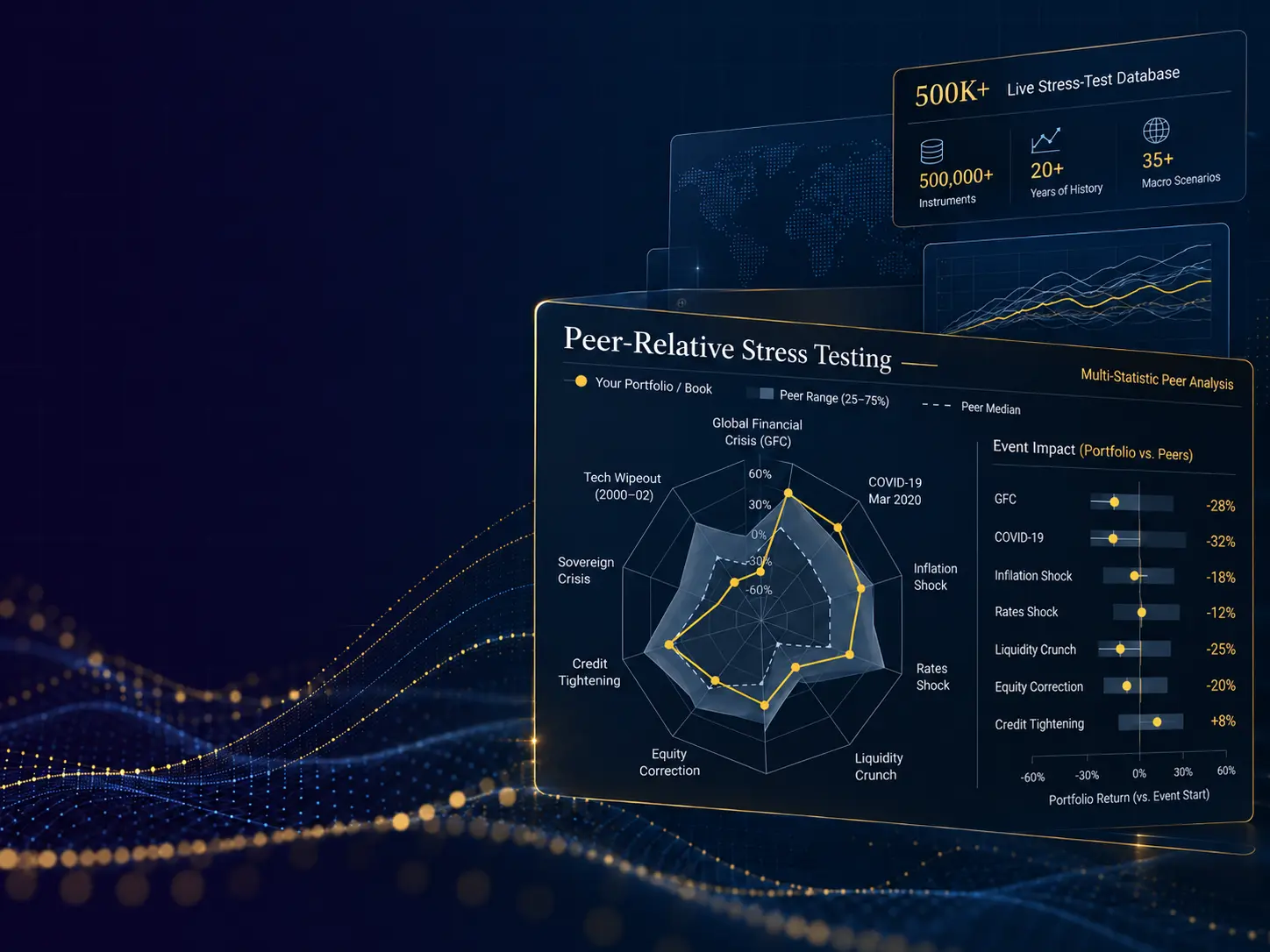
Hedge Fund & Portfolio Stress Testing Software
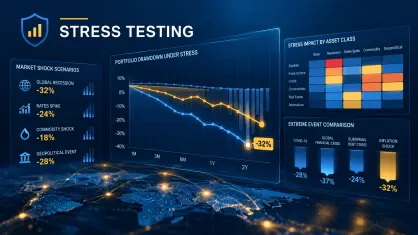
The Risk Shell Stress Testing component is designed to estimate the impact of severe market events on individual investments and multi-asset portfolios. It supports hedge funds, CTAs, long-only funds, equities, fixed income instruments, ETFs, and derivatives.
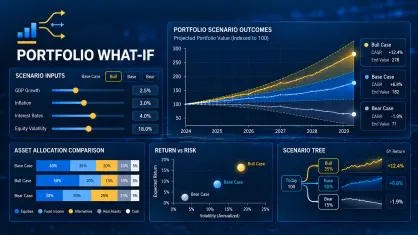
Users can replay historical market shocks, construct their own factor-based stress scenarios, or combine several market and macroeconomic shocks within the same analysis. Stress tests can be applied to a single asset, a group of managers or an entire portfolio, allowing investment teams to identify where losses are likely to originate and which positions or managers contribute most to event risk.
Historical and Predictive Stress Testing
Risk Shell supports two complementary approaches to stress testing. Historical stress tests measure how an asset or portfolio would respond to market conditions observed during past extreme events. These tests are useful for comparing managers across a common set of crisis periods and for assessing whether portfolio diversification remains effective under severe market conditions.
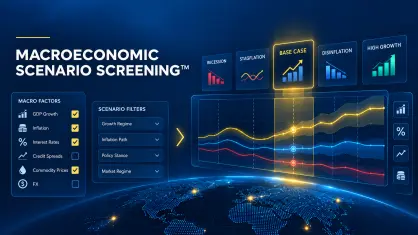
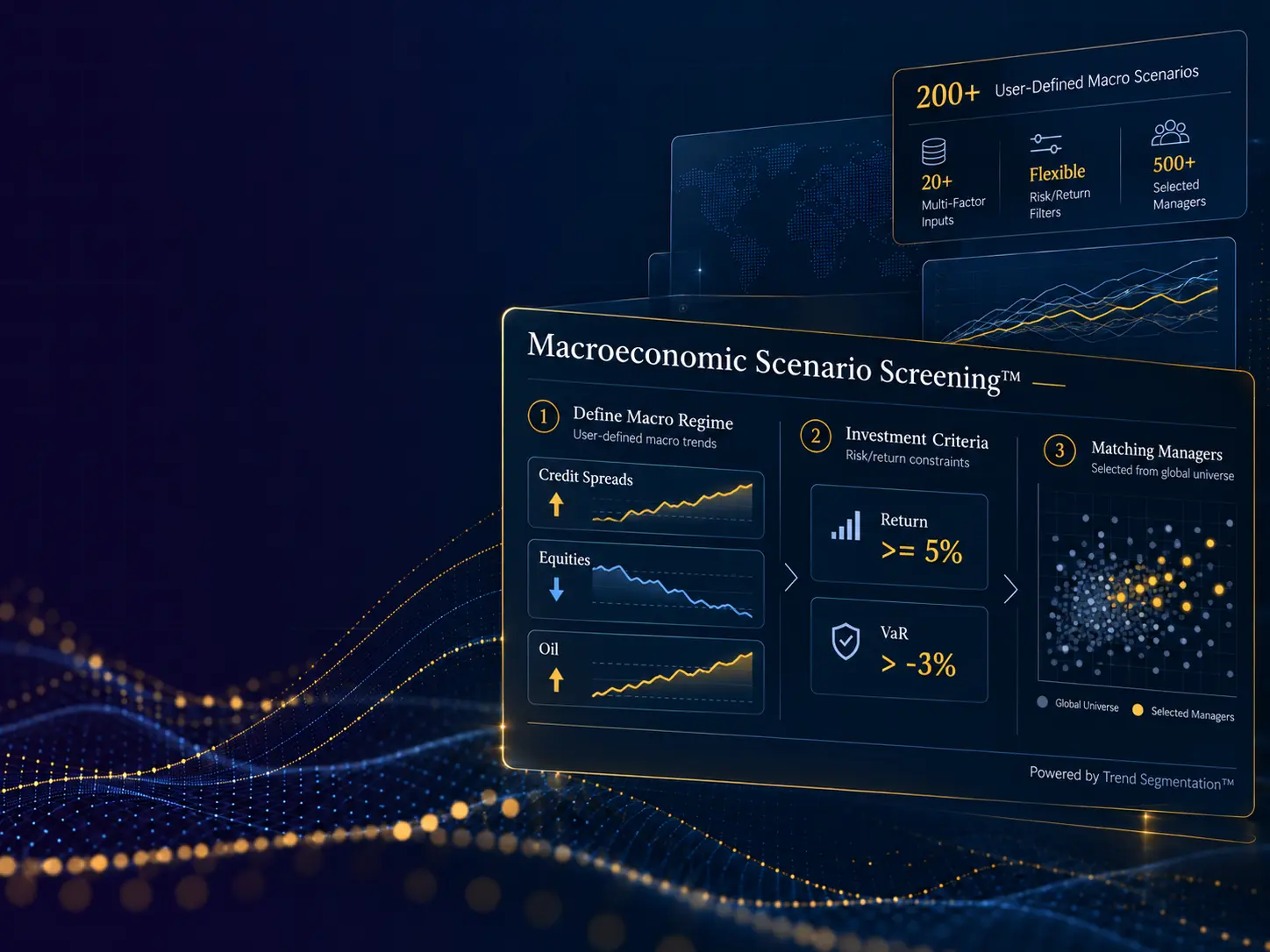
Predictive stress tests are built from user-defined shocks to market and macroeconomic factors. Users can stress one factor at a time or construct multi-factor scenarios involving, for example, falling equity markets, widening credit spreads, rising interest rates, higher volatility, currency moves or commodity shocks.
The objective is not simply to apply an arbitrary percentage loss to a portfolio. Risk Shell estimates how the selected asset or portfolio is expected to respond to the stressed factors on the basis of its estimated or observed factor exposures.
Factor-Based Stress Testing for Hedge Funds
Stress testing hedge funds requires a different approach from the distribution stressing commonly used in bank credit-risk models. The conventional alternative is distribution stressing, as used on a bank credit or trading book. Volatility is scaled, a percentile of the loss distribution is shifted, or the book’s own P&L is replayed over a crisis window. That calculation needs a long, frequent history of the positions under review, and a sample that actually contains the tail. A hedge fund provides neither. Reporting is monthly. Three years of history is about thirty-six points, which cannot fill a 2008-sized tail. The fund may not have existed in the event, so there is no P&L to replay. Marks on illiquid books are serially correlated, and the exposure that generated the recent return may already have changed. Scaling the recent distribution stresses the recent sample. It does not stress the event. Managers can change leverage, net and gross exposure, hedges, sector allocation and factor sensitivities over time. Portfolios may also contain options, derivatives, short positions and non-linear exposures that make simple distribution shifts a poor representation of how the strategy behaves during a market shock.
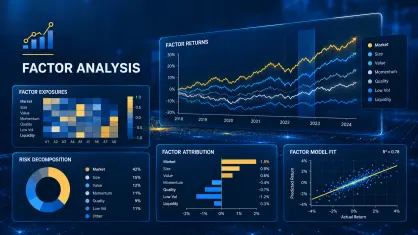
Risk Shell therefore supports factor-based regression models for stress testing. The relationship between an asset's returns and relevant market or macroeconomic factors is first estimated statistically. A stress scenario is then expressed as a set of shocks to those factors, and the factor model is used to estimate the corresponding impact on the asset.
For example, a hedge fund may have exposure to equity markets, credit spreads, interest rates, volatility and commodities at the same time. A predictive stress test can shock several of these factors simultaneously and estimate the combined effect using the fund's factor sensitivities rather than assuming that its historical return distribution simply shifts by a fixed amount.