
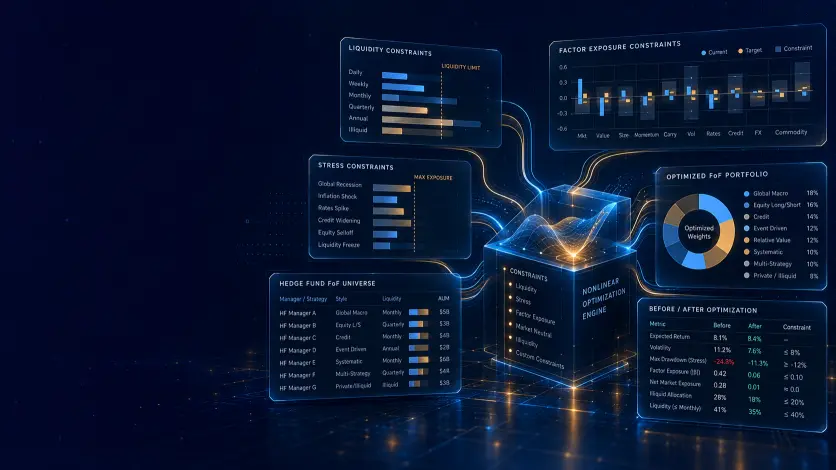
Alternative Investment Management Software
Institutional portfolio management, risk analytics and portfolio construction for alternative and multi-asset portfolios.
Integrated investment data, stress testing, portfolio optimization, alternative investment analytics and shadow accounting within one platform.
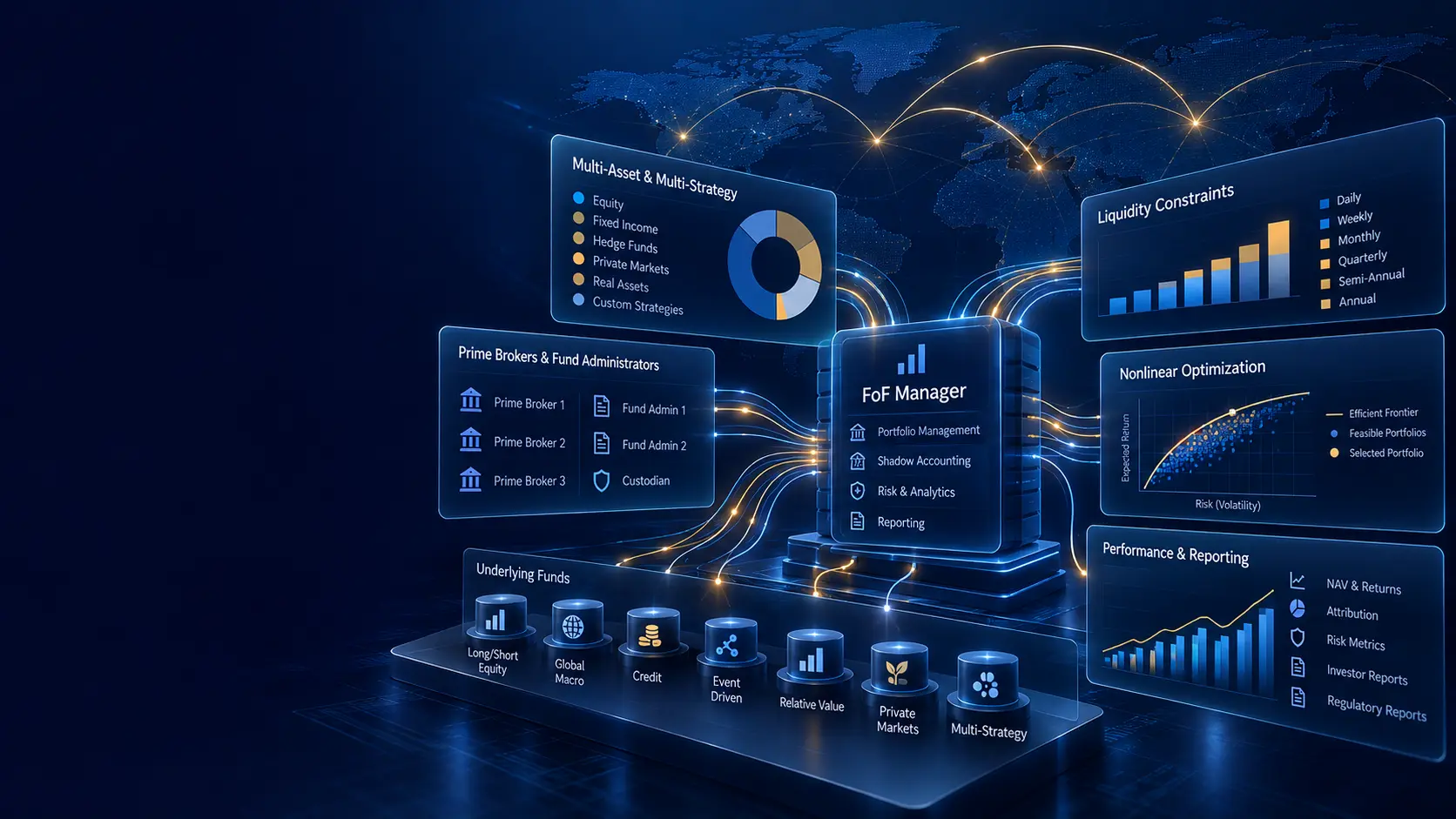
Shadow Accounting for Alternative Portfolios
Manage hedge funds, private equity and multi-asset portfolios with liquidity controls, custom classifications and flexible historical accounting.
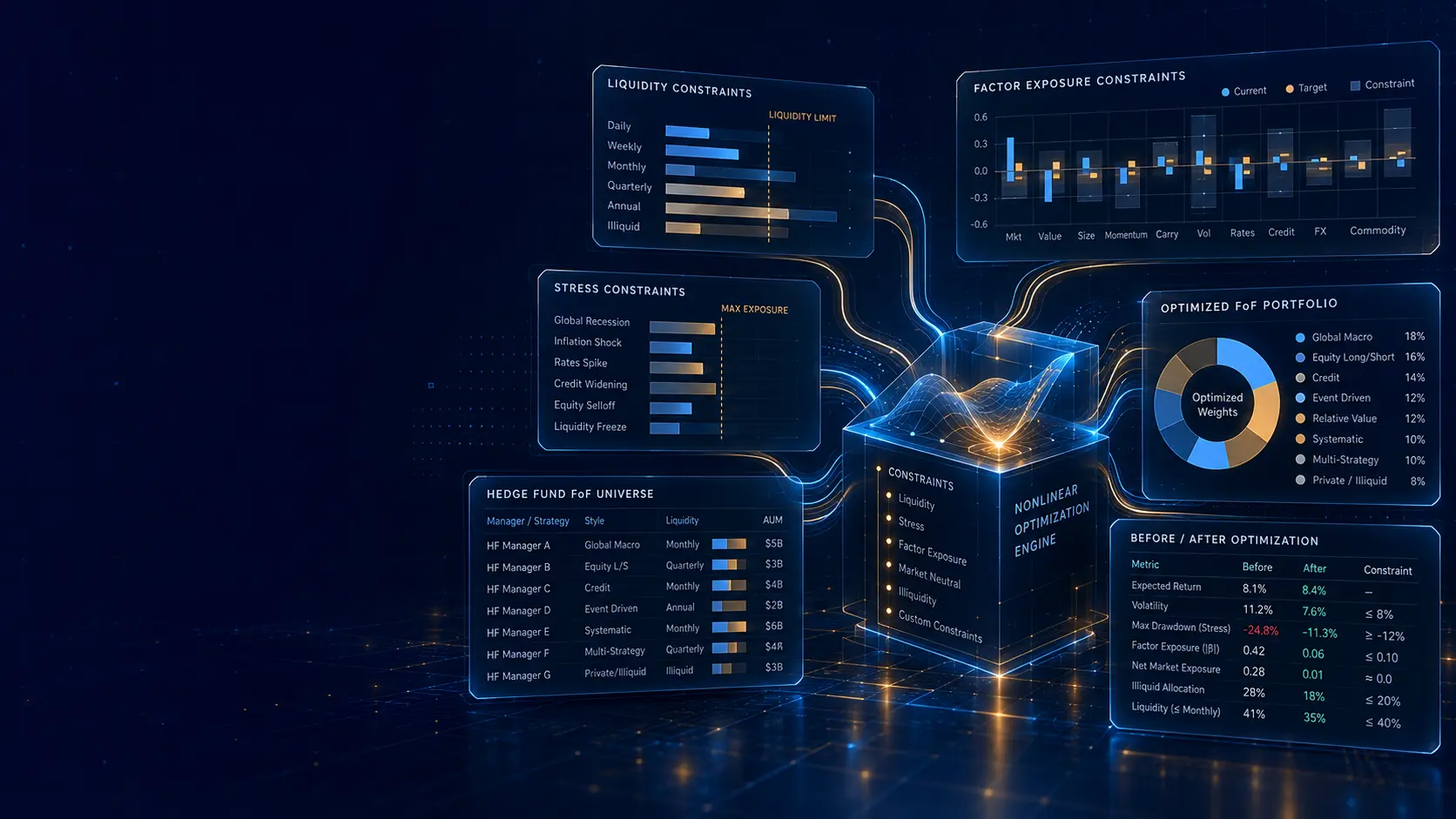
Nonlinear Portfolio Optimization
Construct hedge fund-of-funds and multi-asset portfolios with stress-test, factor-exposure, liquidity and other user-defined constraints.
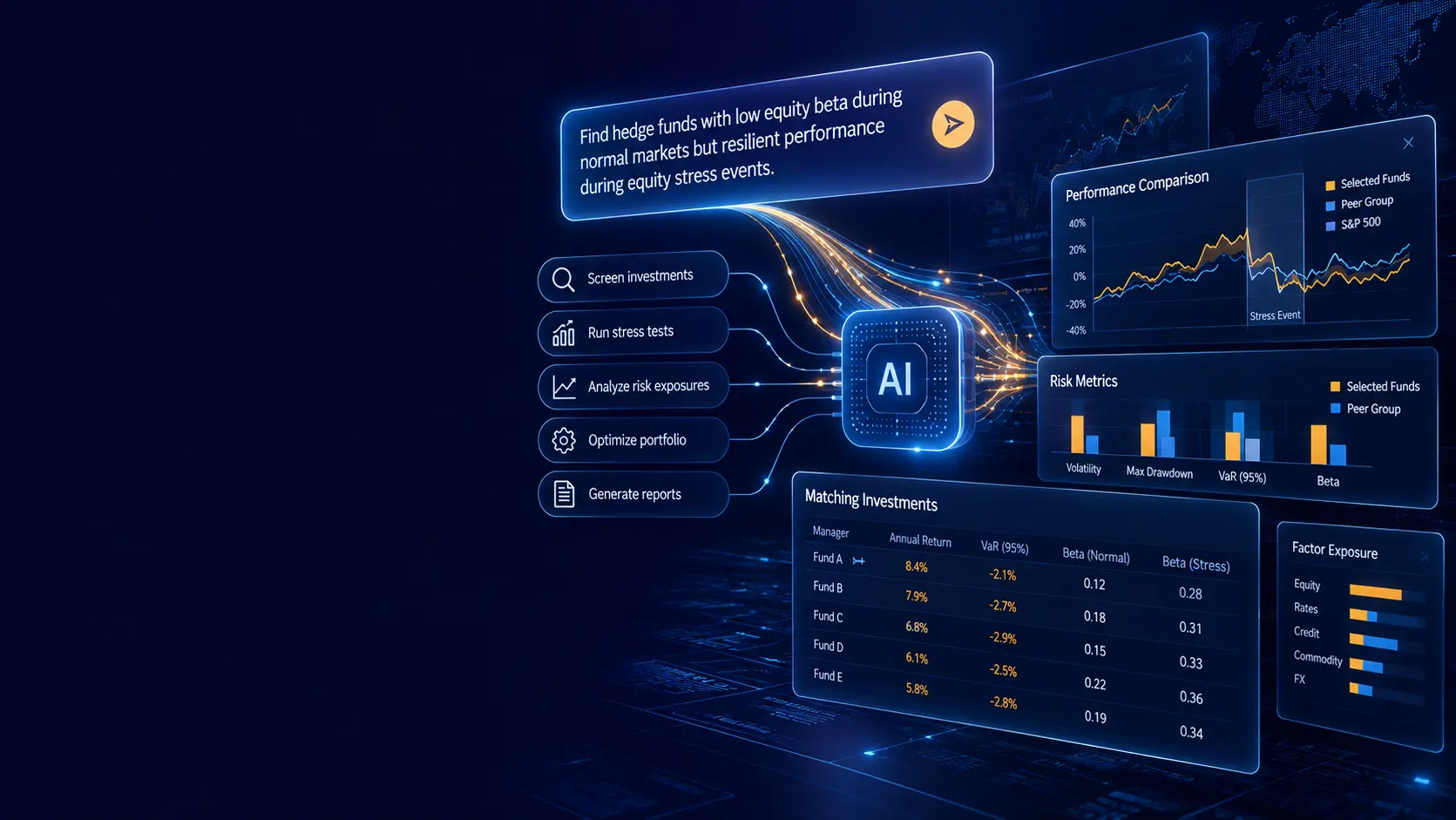
Natural-Language Access to Risk Shell
Use natural language to access investment research, risk analytics and portfolio workflows.
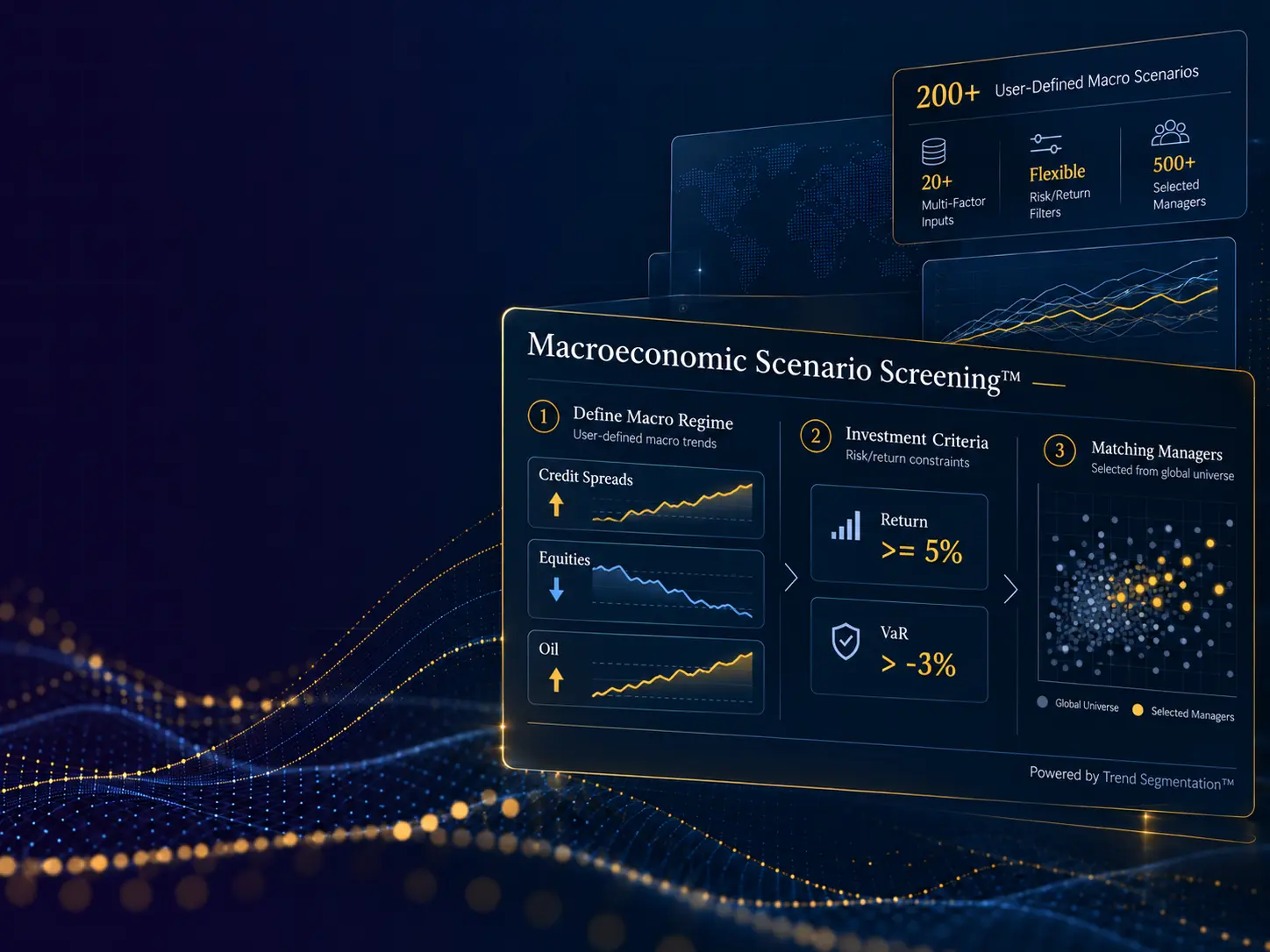
Select Assets for the Scenario You Define
Screen managers by risk and return targets under user-defined macroeconomic scenarios.
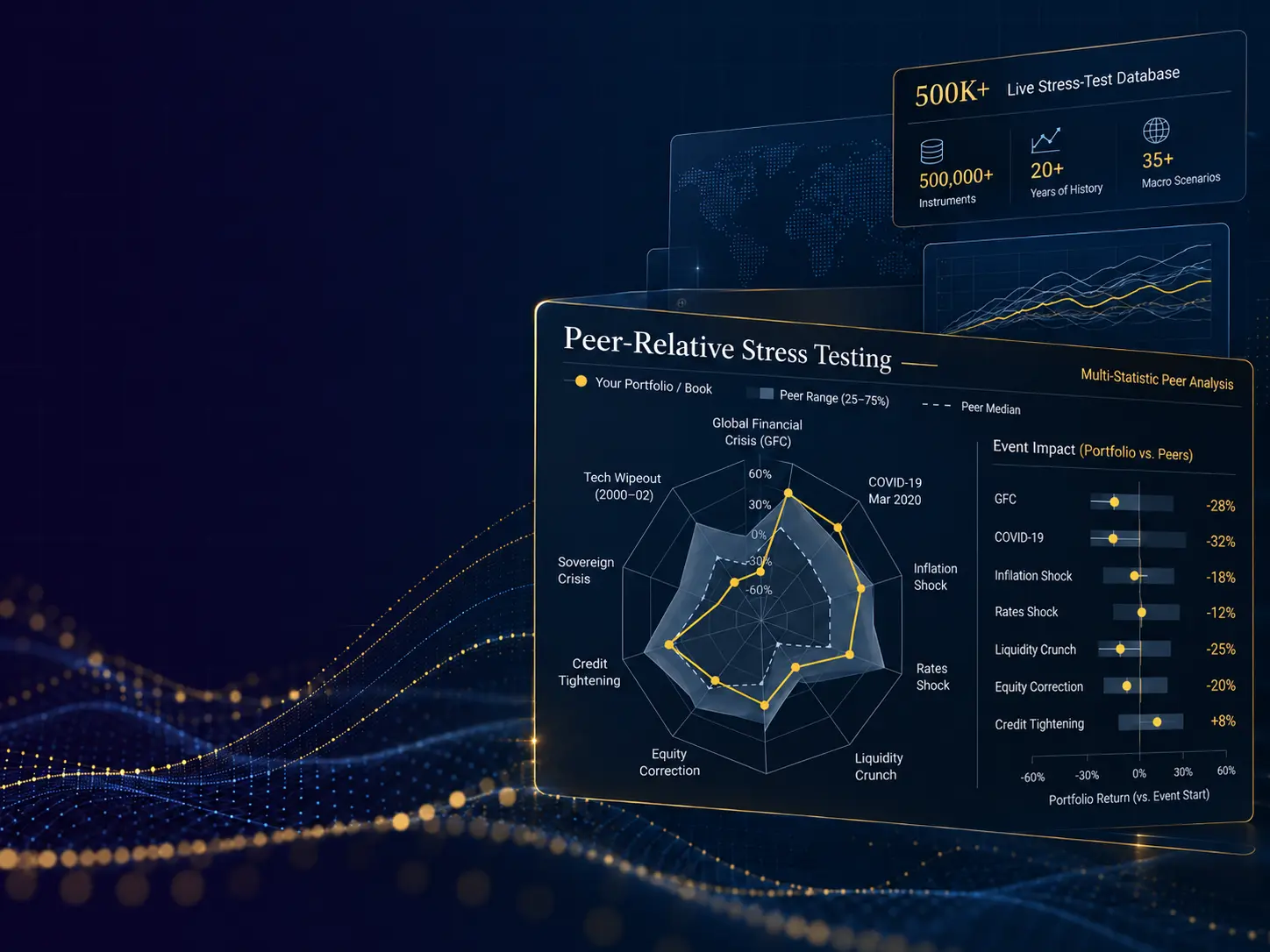
Peer-Relative Stress Testing
Compare extreme-event outcomes with a relevant peer group.
Since Risk Shell was first released in 2013, we have not experienced a network failure that has interrupted our clients' Risk Shell workflows. Nevertheless, the platform is designed with redundant infrastructure for continuity. In the event of an unexpected network or server outage, clients can switch to a redundant server environment that is fully synchronized with the production environment. This provides an operational fallback without requiring clients to rebuild their portfolios, data, or analytical configuration.
Yes. Risk Shell fully supports proprietary data and in-house databases. Institutions can create and maintain their own databases within the Risk Shell environment, or ABC Quant can establish a data bridge between the institution's data infrastructure and Risk Shell. This allows clients to retain control of their internal data while keeping it synchronized with the Risk Shell environment.
Yes. Risk Shell can be configured to match the requirements of each institution. Clients can select the modules, analytical components, and data feeds they require, choose from preconfigured packages, or use a flexible user-defined configuration. Proprietary data can also be incorporated into the platform alongside supported vendor data.
Risk Shell is continuously enhanced through new releases and development requested by clients. Historically, ABC Quant has delivered multiple releases each month, incorporating new functionality, refinements, and enhancements driven by the practical requirements of institutional users.
Risk Shell is hosted within a controlled server environment rather than requiring the analytical application to be installed on each user's workstation. Its security architecture includes network-level protection, access controls, and IP-based validation. The platform has been used by institutional investors whose technology and information-security processes require formal review of analytical systems.
Yes. Risk Shell supports two levels of custom data backup: automatic system backups and user-initiated manual backups. System backups are performed twice daily and are retained for two years, providing an additional recovery option for proprietary datasets and other client-managed information.
Yes. ABC Quant provides data migration services for institutions moving from other analytical or portfolio-management platforms. Migration can cover portfolio allocations, research data, custom assets, and other datasets, with support for a range of existing data formats and source systems.
Yes. Risk Shell provides tools for sharing objects such as portfolios, custom assets, research configurations, and other analytical resources across team members. System administrators can define access rules according to the institution's internal operating and governance requirements.
Yes. Risk Shell can operate with a combination of supported vendor datasets and institution-specific data. Proprietary databases, custom assets, and other internal datasets can be incorporated into the analytical environment alongside licensed external data, allowing institutional users to work from a more complete investment universe.
Yes. Where a data bridge is appropriate, the institution can continue maintaining its own database while selected data is synchronized with Risk Shell. This approach allows clients to preserve their existing data-management processes without requiring all proprietary information to be maintained directly inside the Risk Shell framework.
Yes. Risk Shell supports custom data fields, custom instruments, and institution-defined datasets. These can be incorporated into the analytical environment and used together with vendor data for screening, portfolio analysis, risk assessment, and other research workflows.
Yes. Risk Shell supports structured data integration between institutional systems and the platform. Depending on the implementation, data can be connected through custom integration mechanisms so that proprietary datasets can be incorporated into Risk Shell without requiring users to abandon their established internal data processes.
Yes. Risk Shell includes functionality for controlled sharing of analytical objects between authorized users. Access can be configured for different teams or users, allowing institutions to share common research and portfolio resources while maintaining the access controls defined by their administrators.
Risk Shell is designed for institutional investment environments where portfolio analytics, risk management, proprietary data, external data sources, and team workflows need to operate within a consistent analytical framework. Its configurable architecture allows institutions to combine the Risk Shell modules and data sources relevant to their investment process rather than adopting a fixed workflow.
Risk Shell can apply its portfolio risk analytics directly to underlying holdings. This includes factor analysis, stress testing, VaR, stochastic simulation, correlation and diversification analysis, exposure analysis, and other supported portfolio risk studies.
Not necessarily. Holdings-Based and Returns-Based stress testing measure risk from different perspectives and each has advantages and limitations. Holdings-Based analysis reflects the exposures contained in the reported portfolio, while Returns-Based analysis estimates behaviour from the fund's historical return series. The appropriate method depends on the quality and timeliness of the holdings data, the available return history, and the purpose of the analysis.
Detailed hedge fund holdings are generally obtained directly from the fund manager, subject to the manager's disclosure policy and the investor's reporting arrangements. Commercial hedge fund databases typically do not provide the complete position-level information required for accurate Holdings-Based Analysis. Risk Shell therefore supports direct entry and upload of manager-provided holdings data.
13F data is generally insufficient for full Holdings-Based Analysis of a hedge fund. Form 13F reports qualifying securities at the investment-manager level rather than the complete portfolio of an individual fund. It does not provide a full representation of short positions or many other instruments and asset classes used by hedge funds. Reporting is also quarterly, which introduces a significant timing lag relative to the manager's current portfolio. In addition, 13F reporting applies only to investment managers that meet the applicable reporting threshold. For these reasons, 13F data may provide partial exposure information but should not be treated as a complete hedge fund holdings record.
Yes. When Holdings-Based Analysis is selected for a Fund of Funds portfolio, Risk Shell can aggregate the available underlying holdings for the selected reporting date. This provides a consolidated view of the positions and exposures represented across the underlying funds.
Risk Shell supports an unlimited number of holdings snapshots for each manager or fund. This allows users to retain holdings for multiple reporting dates and analyse changes in portfolio composition and exposures over time.
Yes. Where exact underlying positions are unavailable, users can represent exposures with appropriate indices or other proxy instruments. This approach can be useful for less transparent or illiquid investments, including private equity portfolios, where direct position-level market data may not be available.
Yes. Risk Shell holdings can include supported market instruments as well as user-defined assets and proprietary proxies. This allows institutions to represent exposures that are not adequately covered by standard market instruments or external databases.
FoF Manager offers a function of creating user-defined manager classification systems. It supports two-level categories (strategy and sub strategy) as well as weighted multi-strategies.
Yes. FoF Manager fully supports multi-currency underlying assets. Portfolios are reconciled daily based on EOD exchange rates..
Any regular period frequencies (daily, weekly, monthly etc.) as well as irregular interval NAV entries are supported
Yes. You can hedge multi-currency positions by FX forwards.
FoF Manager supports historical valuation at any given past date as well as incremental valuations between two dates.
FoF Manager offers over 30 redemptions terms including early redemptions and up to 3 subsequent redemptions.
FoF Manager is seamlessly integrated with Risk Shell. Actual portfolio historical NAVs can be used across any Risk Shell components for portfolio risk analysis.
Yes. We offer an option of linking FoF Manager to administrators' data feeds - as a custom development on-demand.
Risk Shell and FoF Manager support two complementary parts of the portfolio rebalancing process. After calculating target portfolio allocations in Risk Shell using portfolio optimization or risk-budgeting models, the proposed allocations can be synchronized with FoF Manager. FoF Manager then calculates the subscriptions and redemptions required to move the current portfolio toward those target allocations. When a portfolio managed in FoF Manager is analyzed historically in Risk Shell, the rebalancing option should be set to “FoF Manager.” This allows Risk Shell to use the actual historical portfolio allocations maintained in FoF Manager rather than applying a theoretical rebalancing assumption.
Yes. Risk Shell fully supports custom data, so you can use your own data without subscribing to vendor databases. There are two ways to integrate custom data. First, you can create and maintain your own databases within the Risk Shell framework. Second, ABC Quant can create a data bridge between our data servers and your servers, allowing you to maintain your in-house databases while synchronizing them with Risk Shell.
Local Risk Shell data is synchronized with the corresponding vendor feeds and is updated whenever the vendor data is updated. Most data feeds are updated daily.
Global equity data serves several purposes. It is required for Holdings-Based Analysis of funds with equity exposure, can be used to build long/short equity portfolios, and allows equity positions to be incorporated into multi-asset portfolios.
Yes. You can subscribe to any of the data packages distributed by ABC Quant without subscribing to Risk Shell analytics. We offer various data delivery options, including FTP and SFTP, with encrypted or unencrypted delivery.
Risk Shell and data subscriptions are separate licenses, although some Risk Shell packages include selected data feeds. Most data feeds can be subscribed to either through ABC Quant or directly from supported data vendors. If you obtain a data license directly from a vendor, access to the relevant database will be enabled after your license has been verified.
Risk Shell does not maintain fixed-income data within its standard environment. However, you can obtain virtually any financial instruments, including bonds, through the integrated Bloomberg data feed or upload them manually as custom assets.
Yes. Risk Shell provides two levels of custom data backup: automatic system backups performed twice a day and user-initiated manual backups. System backups are retained for two years.
Duplicates can occur when you subscribe to multiple data feeds covering the same asset class. Risk Shell provides dedicated tools for eliminating duplicates across multiple data vendors based on user-defined rules.
Yes. Risk Shell allows complex searches that combine quantitative criteria with qualitative or descriptive fields. This makes it possible to narrow the search using characteristics such as asset type, strategy, classification, or other descriptive attributes together with numerical measures such as returns, volatility, liquidity, valuation, or risk statistics.
Factor Screening identifies instruments with specified sensitivities, or betas, to selected economic factors, market indices, or benchmarks. It can be used to find assets with particular factor exposures and to support factor-based research, portfolio construction, and risk analysis.
Yes. Risk Shell provides regression-based search functionality that allows you to identify instruments within a specified correlation or regression range relative to a reference asset, index, or benchmark. This can be useful for finding instruments with similar, complementary, or specific market relationships.
Yes. Risk Shell supports quantitative searches over defined historical periods, including both trailing and closed time intervals. This allows search criteria to be evaluated consistently over the period relevant to your analysis rather than relying only on current values.
Yes. User-defined data fields can be included in Risk Shell searches in the same way as supported vendor data fields. This allows institutions to incorporate proprietary classifications, internal metrics, and other custom information into their screening criteria.
Yes. Custom instruments and user-defined datasets can be organized as virtual databases within Risk Shell. They are integrated with vendor databases and can therefore be included in the same search and screening routines.
Yes. Risk Shell supports quantitative screening across a broad range of investment instruments and datasets. Depending on the available data, search criteria can include performance characteristics, risk measures, exposures, classifications, and other quantitative or descriptive fields.
Yes. Risk Shell can use quantitative risk and performance measures as screening criteria. This allows users to search for instruments or funds according to characteristics such as historical performance, volatility, downside risk, tail-risk measures, and other available analytics.
Yes. Factor-based screening can be used to identify instruments according to their estimated sensitivities to selected market, economic, or benchmark factors. This provides a practical way to search for specific sources of systematic exposure rather than relying solely on asset-class or descriptive classifications.
Yes. Risk Shell's quantitative search capabilities can be used to identify instruments with specified statistical relationships to a reference instrument or benchmark. Correlation, regression characteristics, factor sensitivities, and other available quantitative measures can help identify instruments with similar or contrasting historical behaviour.
Yes. Risk Shell is designed for multi-criteria searches, allowing users to combine several quantitative and descriptive conditions. Complex screening rules can therefore be used to narrow large instrument universes to a specific set of assets or funds matching the required characteristics.
Yes. Risk Shell can integrate data from supported vendor databases together with user-defined data and custom instruments. These datasets can be incorporated into the search environment, allowing screening criteria to be applied across a combined investment universe.
Quantitative screening can support a wide range of institutional investment research tasks, including investment universe selection, manager and fund research, factor analysis, portfolio construction, benchmark-relative analysis, and identification of instruments with specific risk, return, correlation, or exposure characteristics.
Traditional risk models are primarily designed for liquid, frequently traded assets with observable market prices and relatively short measurement intervals. Private equity presents different modelling challenges, including illiquidity, infrequent valuations, long investment horizons, irregular cash flows, portfolio concentration, and potentially nonlinear investment outcomes. These characteristics require risk analysis designed specifically for private-market investments rather than simply applying conventional public-market assumptions.
Private equity and real estate share important cash-flow characteristics. Both typically involve long-term investments, capital contributions or reinvestments, and subsequent distributions or operating income. These cash-flow dynamics make private-equity-style modelling applicable to many real estate investments, particularly where valuation and liquidity cannot be assessed in the same way as publicly traded securities.
Traditional finance education has historically focused on publicly traded securities and market-based risk measures for which large amounts of standardized, high-frequency data are available. Private equity requires a different analytical framework because investments are illiquid, valuations may be periodic rather than continuously observable, and performance depends heavily on investment-level cash flows, transaction timing, and long-term portfolio dynamics. As a result, private equity risk management is generally a more specialized area of institutional investment analysis.
Yes. ABC Quant provides customized training for new Risk Shell clients at no additional cost. Training can be tailored to the user's investment and risk-management requirements and can include private equity risk modelling, cash-flow analysis, performance measurement, portfolio analytics, and the practical use of Risk Shell's private-equity tools.
Traditional IRR is calculated directly from the investment's actual cash flows and is therefore specific to the timing and magnitude of those cash flows. Risk Shell's Index IRR provides an index-based approach for analysing private equity performance by relating investment outcomes to the behaviour of a selected reference index. It can therefore be used as an additional performance perspective alongside traditional cash-flow-based IRR and other private-equity performance measures.
KSPME is a Risk Shell statistic designed to provide an additional way of analysing private equity performance and risk where investment cash flows are irregular and outcomes are uncertain. Rather than relying exclusively on a single IRR figure, KSPME can be used within a broader analysis of the distribution of potential investment outcomes. This makes it particularly relevant for institutional investors assessing private equity investments and portfolios where cash-flow uncertainty is an important component of risk.
Direct Alpha is a private-market performance measure that evaluates investment performance relative to a selected public-market benchmark by translating private equity cash flows into a benchmark-relative framework. It provides an additional perspective on value creation that can complement traditional measures such as IRR and multiple-based performance statistics.
Yes. ABC Quant provides custom data integration for institutions that use multiple private equity data sources. Vendor databases and proprietary in-house datasets can be connected to Risk Shell and consolidated into an integrated analytical environment. This allows users to work with their existing data while applying Risk Shell analytics across the combined private equity dataset.
Yes. Risk Shell is designed to support analysis at both the investment and portfolio levels. Private equity holdings can be aggregated to analyse portfolio-level exposures, concentration, cash-flow behaviour, performance, and other relevant risk characteristics. This provides an institutional framework for evaluating the interaction of individual private-market investments within a broader portfolio.
Yes. Risk Shell includes cash-flow forecasting capabilities for private-market portfolios. Historical investment and distribution patterns can be analysed to support forecasts of future capital calls, distributions, and portfolio cash requirements. These analyses can be useful for liquidity planning, commitment management, and portfolio-level risk assessment.
Yes. Risk Shell provides several ways to place private equity performance in a broader market context, including benchmark-based and index-based analysis. Depending on the methodology selected, institutional investors can compare private-market outcomes with relevant public-market indices while retaining the underlying private equity cash-flow information.
Yes. Risk Shell can incorporate stress-testing and scenario-analysis techniques into private-market portfolio analysis. This allows institutions to examine how changes in assumptions, market conditions, valuations, or cash-flow patterns may affect portfolio-level outcomes and risk.
Yes. Private equity investments can be analysed alongside traditional and other alternative asset classes within a broader multi-asset portfolio framework. This allows institutions to assess private-market exposures together with public equities, fixed income, hedge funds, commodities, and other investments when evaluating overall portfolio risk and diversification.