

Alternative Investment Management Software

Risk Shell

Institutional portfolio management, risk analytics and portfolio construction for alternative and multi-asset portfolios.

Integrated investment data, stress testing, portfolio optimization, alternative investment analytics and shadow accounting within one platform.

FoF Manager hero
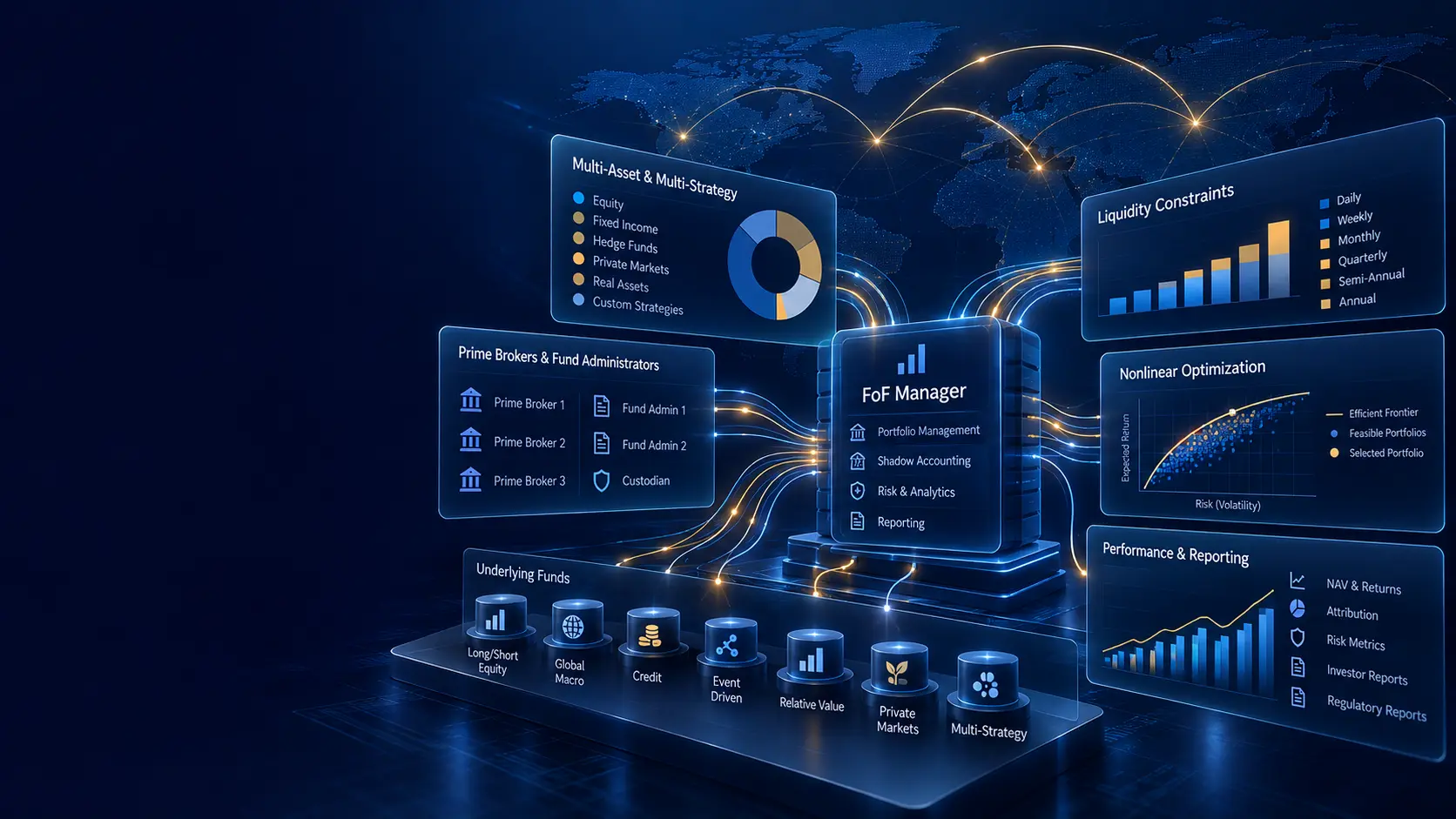
FoF Manager

Shadow Accounting for Alternative Portfolios

Manage hedge funds, private equity and multi-asset portfolios with liquidity controls, custom classifications and flexible historical accounting.

35+ hedge fund liquidity settings
Explore FoF Manager
Optimization hero
Portfolio Optimization

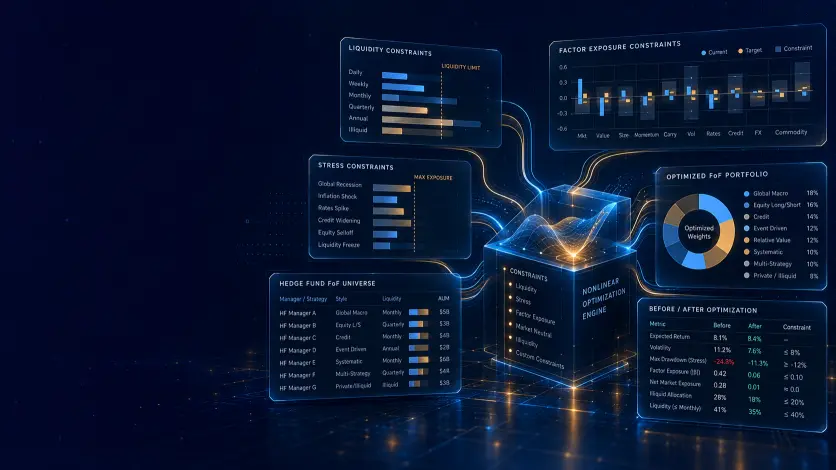
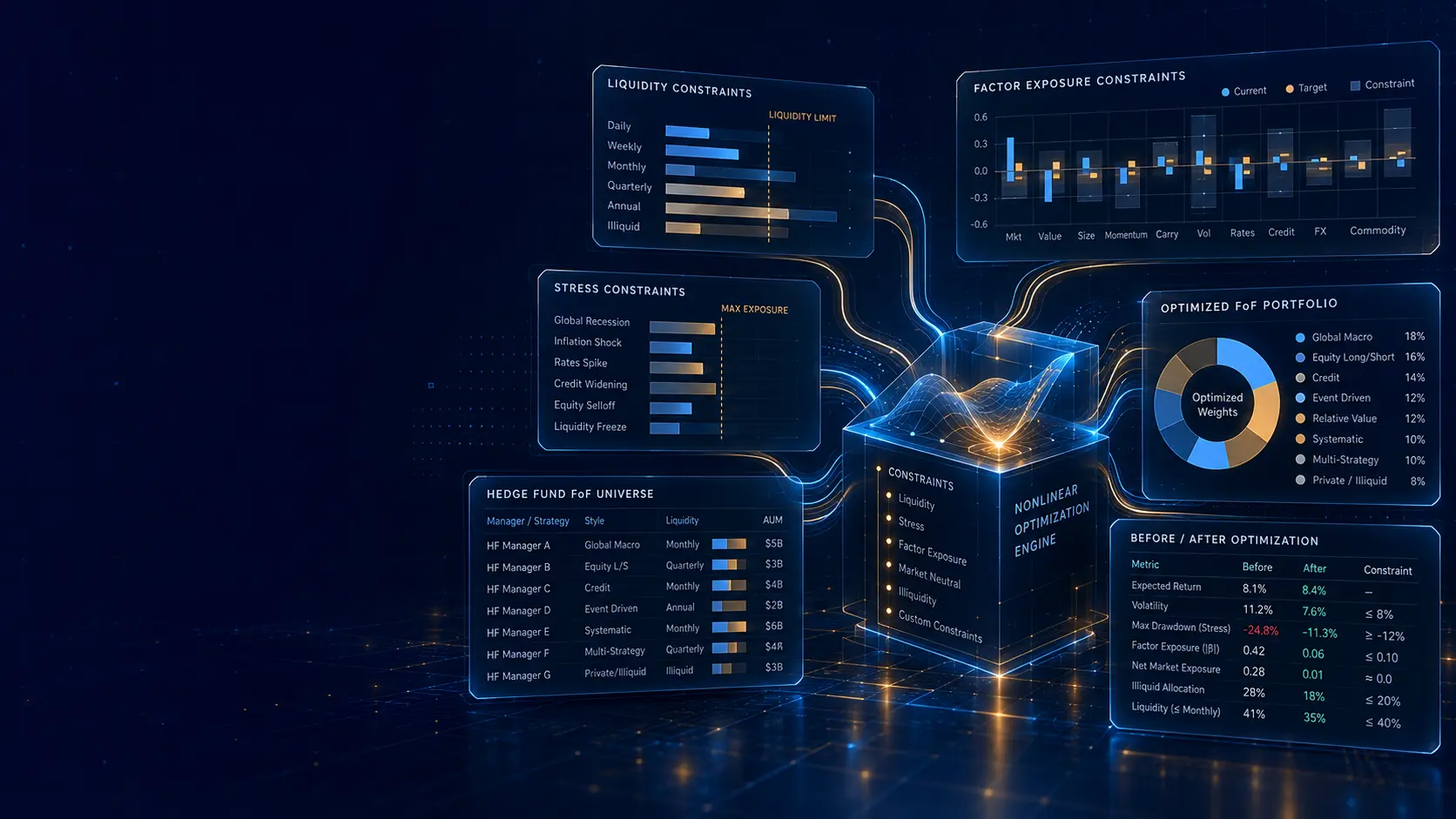
Nonlinear Portfolio Optimization

Construct hedge fund-of-funds and multi-asset portfolios with stress-test, factor-exposure, liquidity and other user-defined constraints.

Custom Constraints for market-neutral and risk-controlled portfolio construction
Explore Portfolio Optimization
Risk Shell AI hero
Risk Shell AI

Natural-Language Access to Risk Shell

Use natural language to access investment research, risk analytics and portfolio workflows.

2.3B tokens in our in-house financial LLM
Explore Risk Shell AI
Macroeconomic Scenario Screening hero
Macroeconomic Scenario Screening

Select Assets for the Scenario You Define

Screen managers by risk and return targets under user-defined macroeconomic scenarios.

Trend Segmentation™ proprietary regime-analysis engine
Explore Scenario Screening
Peer-relative Stress Testing
Portfolio Stress Testing

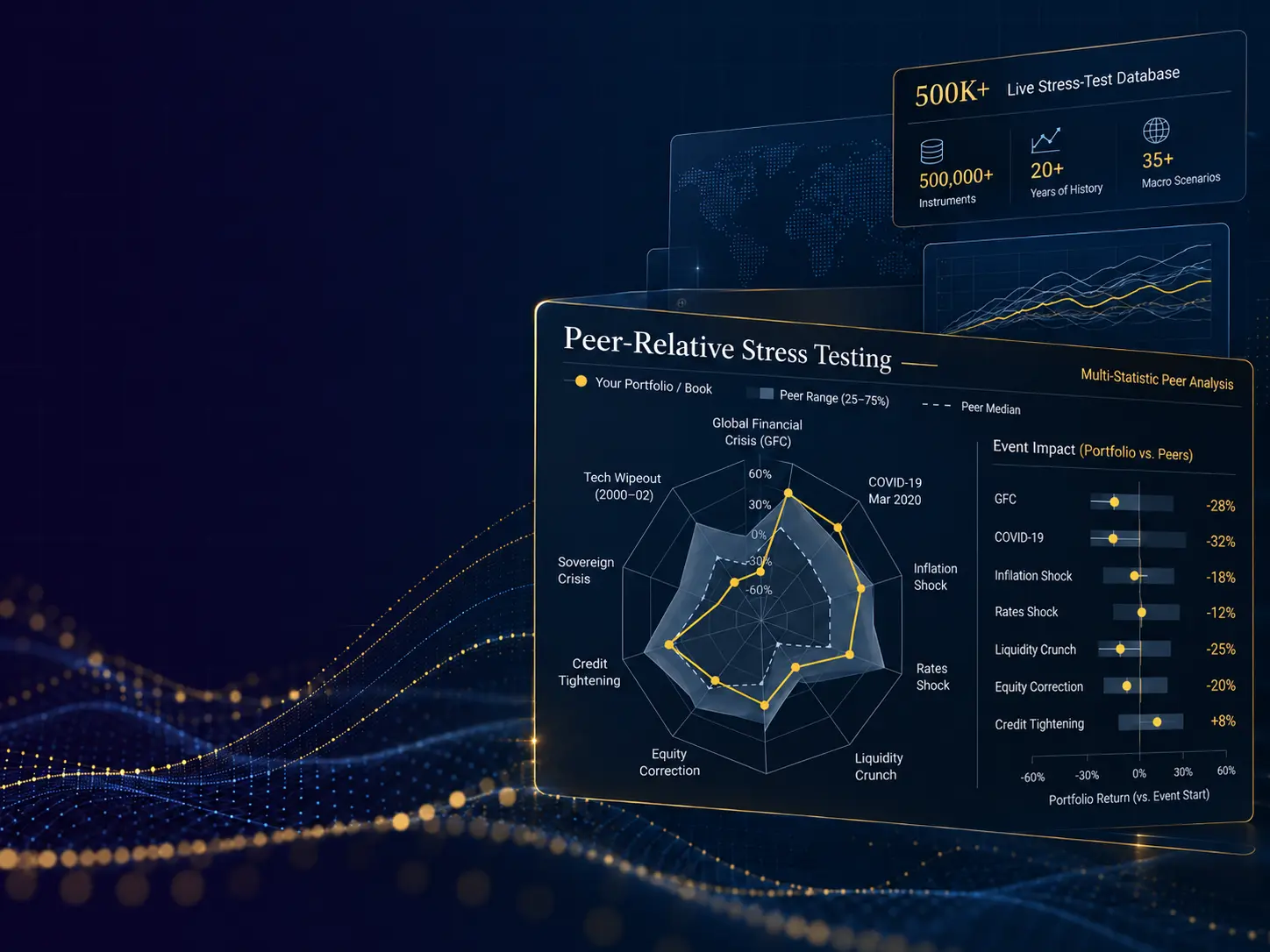
Peer-Relative Stress Testing

Compare extreme-event outcomes with a relevant peer group.

500K+ live stress-tested instruments
Explore stress testing

Portfolio Risk Analysis

Inheriting all valuation problems of individual funds and single asset classes, multi-asset investment portfolios, especially with a high concentration of hedge funds (hedge fund of funds – HFoF), are prone to additional levels of risk.

First, HFoFs tend to exhibit higher negative skewness and kurtosis than individual funds or traditional asset classes. Therefore, the inappropriateness of the mean-variance theory, which assumes a normal distribution, applies to HFoF to a higher extent. Put simply, relying on standard deviation and its related risk metrics to gauge market risk can lead to either overestimating or underestimating the actual risk levels due to the non-normal distribution of hedge funds.

Second, the diversification of portfolio constituents leads to a higher portfolio correlation with major markets compared to individual funds. Therefore, increasing a portfolio’s number of assets doesn’t necessarily improve its diversification and market neutrality.

Third, complex multi-asset portfolios with diverse asset allocations require measuring risks across all risk categories: market risk, liquidity risk, currency risk, inflation risk, concentration risk, volatility risk, strategy risk, operational risk, legal risk, and fraud risk.

Finally, high cross-correlations across underlying funds and indices make portfolio attribution and factor analysis more difficult - often classic regression models do not work and more advanced techniques should be applied.

Hedge Fund Of Funds and Multi-asset Portfolios Valuation Challenges

  • A greater degree of non-normality of return distributions compared to individual funds, which makes the mean-variance framework and standard deviation derived risk statistics hardly applicable. Consequently, alternative statistics capable of analyzing various return distributions, such as Value-at-Risk, Omega, Kappa, Conditional Value-at-Risk (CVaR), and Expected Tail Loss (ETL), are employed. However, leveraging advanced statistics introduces additional challenges and computational complexities.
  • High portfolio correlation with indices. While diversifying across various asset classes is a typical strategy to mitigate this, it may not be as effective with alternative investments like hedge funds. In fact, adding more hedge funds to the portfolio often leads to increased correlation with major market indices.
  • Excessive cross-correlations among underlying funds can significantly degrade portfolio diversification. Our findings regarding the optimal number of hedge funds in a portfolio are consistent with François-Serge Lhabitant's research in "Diversification, Rational Expectations, and the Sector Risk Model." The ideal number of assets in a multi-asset portfolio or a hedge fund of funds falls within the range of 15 to 18.

What We Can Do For You

Our on-demand portfolio risk assessment services encompass the following offerings:

  • Advanced hedge fund portfolio factor analysis (Kalman filters, Elastic-net, LASSO, the Akaike information criterion etc.)
  • Portfolio stochastic simulation
  • Marginal risk contribution analysis
  • Portfolio Sensitivity analysis
  • VaR and tail-risk analysis through different Value-at-Risk models, e.g. Hybrid or Modified VaR
  • Principal Component analysis
  • Extreme event Stress testing including correlation stressing
  • Portfolio What-if analysis
  • Distribution adjustment analysis
  • Structured products' analysis (on-demand)
  • Portfolio Cross-correlation and diversification analysis

Explore ABC Quant Research On-demand Programs

Project-based and ongoing quantitative research tailored to clients' needs

  • Quantitative assessment of hedge funds and alternative investment vehicles using Risk Shell risk, factor and stress-testing models.

    • 100+ risk and return statistics
    • Factor, drawdown and tail-risk analysis
    • Peer-relative and stress-test assessment

    Explore Fund Risk Assessment

  • Construction of hedge fund, fund of funds and multi-asset portfolios using manager-selection and portfolio-allocation models.

    • Manager and asset screening
    • Risk budgeting and allocation analysis
    • Portfolio What-If and constraint testing

    Explore Portfolio Construction

  • Nonlinear portfolio optimization across alternative and multi-asset portfolios using Risk Shell's optimization engine.

    • Multiple objective functions and risk measures
    • Liquidity, factor and stress-test constraints
    • Optimization backtesting and rebalancing

    Explore Portfolio Optimization

  • Operational due diligence on hedge funds including quantitative and qualitative assessment.

    • Peer, factor and stress-test analysis
    • DDQ and custom due diligence fields
    • Manager interviews to evaluate trading strategies

    Explore Due Diligence

  • Factor-based analysis of manager exposures, investment style and strategy drifts over time.

    • Static and Dynamic Attribution Analysis
    • LASSO, PCA, AIC and Ridge factor models
    • Trend Segmentation™ and style-drift analysis

    Explore Style Analysis

  • Quantitative review of portfolio bottlenecks using stress tests, factor, scenario and optimization models available in Risk Shell.

    • Factor-exposure and concentration diagnostics
    • Macroeconomic Scenario Screening™
    • Optimization and allocation backtesting

    Explore Strategy Enhancement